The Flood Map Matters More Than The House
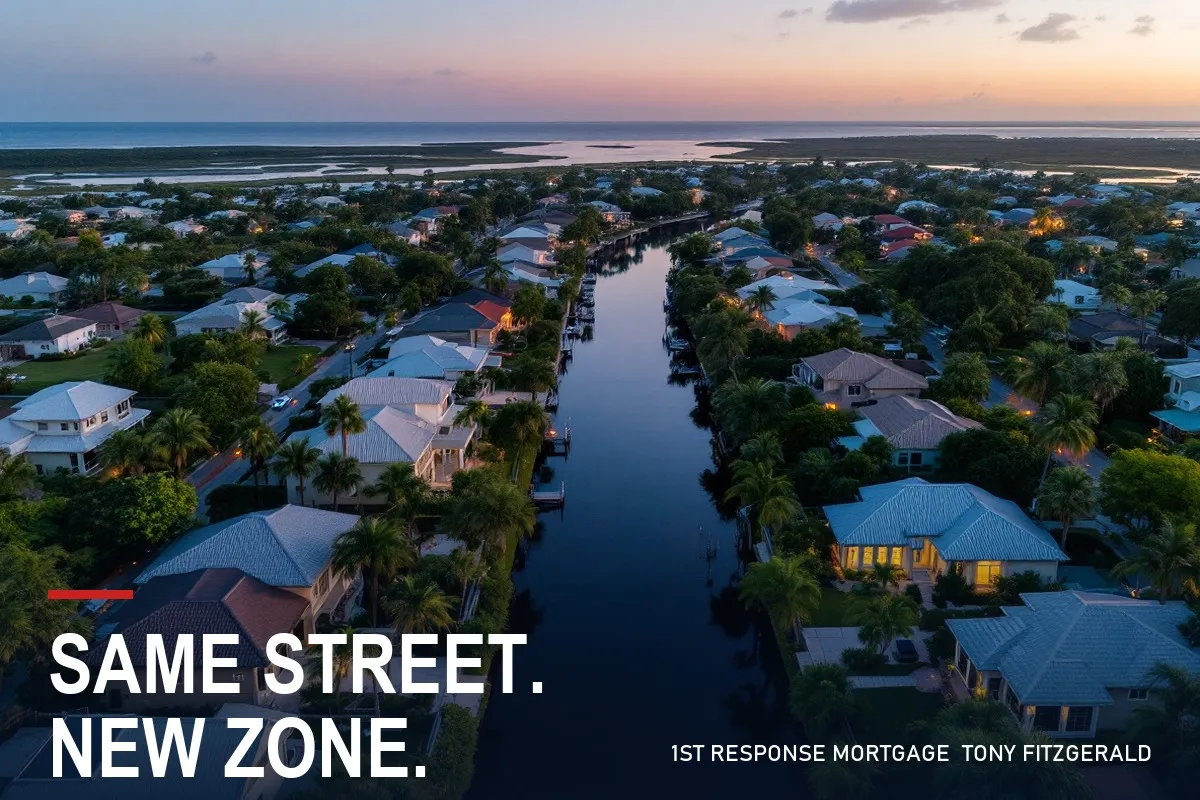
Two houses on the same street. Same builder, same year, same floor plan, both dry through every storm anybody can remember.
One of them needs flood insurance. The other does not.
Buyers find this genuinely hard to accept, and I understand why. It feels arbitrary. It is not, and once you see how the lines work, you can check it yourself in about five minutes before you ever write an offer.
Where the requirement comes from
Flood zones are drawn on federal flood maps. Those maps divide land by flood risk, and the boundaries follow elevation and water flow rather than streets or property lines. That is why a line can cut through the middle of a block.
If a property sits in one of the higher risk zones and you are getting a federally backed mortgage, flood insurance is required. Not recommended. Required, as a condition of the loan.
Your lender does not decide this and cannot waive it. We pull a determination on the property and the answer is whatever the map says.
Why it matters to your payment and your approval
Flood insurance is a separate policy from your homeowners insurance. It is an additional premium on top, and in Florida it is not a small line item.
If your taxes and insurance are escrowed, that premium is collected in your monthly payment. Which means it is part of the number you pay every month, and part of what a lender counts when deciding whether you qualify.
So discovering a flood requirement late does two things at once. It raises your real cost of ownership, and it can move your qualifying numbers on a house you are already emotionally committed to. That is a bad week, and it is completely avoidable.
Check before you offer, not after
You can look up a property's flood zone yourself on the federal flood map service before you ever write an offer. It takes minutes and it costs nothing.
Do that on any property you are seriously considering. If it comes back in a higher risk zone, get a flood insurance quote before your inspection period runs out, so you are deciding with a real number instead of a rumor.
And ask the seller whether they carry flood coverage now and what they pay. It is a fair question and the answer is informative either way.
The thing that surprises people most
Maps change.
They get revised as communities grow, as drainage changes, and as the modeling improves. A property that was in a lower risk zone at some point can be redrawn into a higher one, and the reverse happens too.
So the answer your neighbor got for their house several years ago is not necessarily your answer today, even on the same street. Pull the current determination for the actual address.
There is also a process for challenging a determination when a specific property sits high enough that the map does not reflect it accurately. It involves an elevation certificate from a surveyor and it is not fast, but on the right property it is worth knowing the option exists.
Low risk does not mean no risk
This is the part I want people to actually hear.
Plenty of flood claims come from properties that were not in a high risk zone and were not required to carry coverage. Heavy rain does not read the map. And standard homeowners insurance generally does not cover flood damage, which is a distinction a lot of people only learn at the worst possible time.
In a lower risk zone, coverage is optional and typically much less expensive than in a high risk zone. That is a real conversation worth having with your insurance agent rather than defaulting to no.
I am not your insurance agent and I am not going to tell you what to buy. I will tell you that in this state, treating flood as somebody else's problem because a map said so has not aged well for a lot of people.
The short version
Flood zone is a property fact, not a house fact. It is set by a map, it is required by your loan if the map says so, and it lands inside your monthly payment.
Look it up before you write the offer. Get a quote during your inspection period. Ask about coverage even if you are not required to carry it.
Send me an address and I will pull the determination and tell you what it does to your payment before you are in too deep to change course.
Talk it through
Have a question about your own situation? I answer the phone. No pressure, no pitch, and if your current plan is the right one I will tell you that.
See what to check before you offer
Already have a quote? Get a second look
Run the numbers on the calculator
More from Tony
1rmtg.com home · About Tony · How I run a mortgage call · All Field Notes posts
Loan programs: All loan options · First-time buyer · Self-employed · Refinance · HELOC and home equity · Non-warrantable condos
Where I lend: Sarasota · Lakewood Ranch · Bradenton · Venice · Every Florida location
Still have a question? 74 mortgage questions, answered straight
Tony Fitzgerald, NMLS #1284924. 1st Response Mortgage, powered by Mpire Financial Group LLC, NMLS #2108504, Florida Mortgage Lender License #MLD2467. Equal Housing Lender. NMLS Consumer Access: nmlsconsumeraccess.org. This article is general education, not financial, tax, or legal advice, and not an offer of credit or a commitment to lend. Terms vary by borrower, property, and transaction, and program guidelines change over time.
