When a Parent Co-Signs Your Mortgage: What They Really Sign
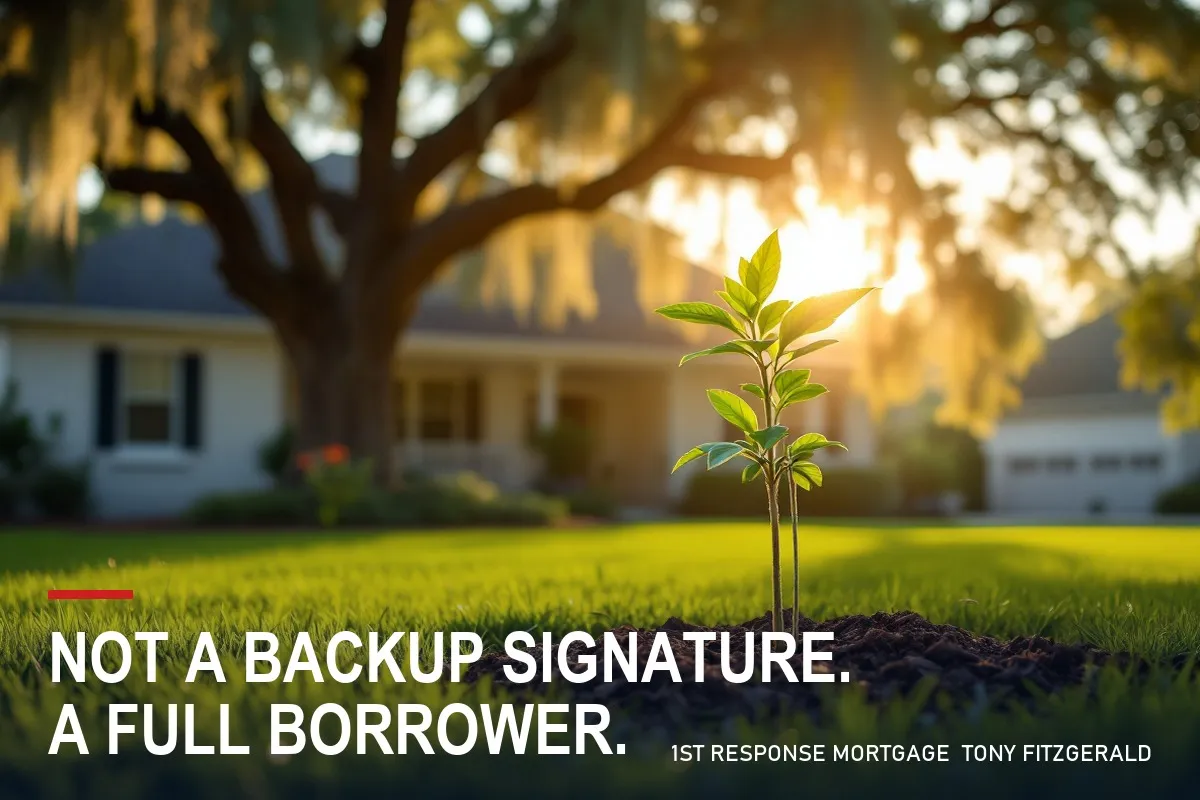
Mom or Dad offers to "co-sign" so you can buy. Real quick, here is the thing nobody says out loud at the kitchen table. On most home loans, that parent is not a backup signature. They become a full borrower on the loan, on the hook for every payment, and the loan shows up on their credit like they bought the house themselves.
That can absolutely be the right move. Just walk in knowing what it is.
What does a parent actually sign up for?
In mortgage language, a relative who helps you qualify but will not live in the home is usually called a non-occupant co-borrower. They sign the note, which is the promise to repay, and they share full liability with you. If a payment is late, it is late on both of your credit reports. If the loan goes bad, the lender can come after either of you.
At least one borrower has to live in the home as their primary residence. That is you. The parent keeps living in their own house.
How does it work on a conventional loan?
Under Fannie Mae's guidelines, a non-occupant borrower may or may not be on title, depending on how the loan is set up. There is also a version called a guarantor or co-signer who signs the note but is not on title at all. Same liability, no ownership. Which structure makes sense depends on the family and the lender, and it is worth a real conversation about who should own what.
On income, the automated underwriting system looks at everybody's income, debts, assets and credit together. That blending is what lets a parent's income help you qualify. If a file gets manually underwritten instead, the rules tighten. The person living there generally has to qualify largely on their own income, and in many cases has to bring the first five percent of the down payment from their own money.
Also, with a non-occupant borrower on a conventional file, plan on at least five percent down under Fannie's automated guidelines, not the three percent some first-time buyer programs allow.
How does it work on an FHA loan?
FHA is friendlier to family, with a catch. A non-occupying co-borrower goes on the title and the note. They need to be a U.S. citizen or have their principal residence in the U.S.
If the co-borrower is a family member, FHA generally allows the normal minimum down payment on a one-unit home, which is three and a half percent. If the co-borrower is not family, the loan is generally capped at seventy-five percent of the value, meaning roughly twenty-five percent down. So a parent works. A buddy from work mostly does not.
FHA is also clear that this setup is for helping a family member own a home they live in. It is not a way to stack up rentals.
What does it do to the parent's own borrowing later?
This is the part parents miss. That mortgage payment now counts as their debt. When they go to refinance, buy a condo in Venice, or take out a HELOC, a lender will see your loan on their credit and count the payment against their debt-to-income, meaning the share of monthly income already spoken for by debt.
There is a way out on conventional loans. Fannie Mae lets the lender leave that payment out of the parent's numbers if you are also on the loan and you have made the payments yourself for the most recent twelve months, with no late payments, documented with your bank statements or canceled checks. So pay it from your own account. Every month. If Dad pays it "just this once," you just restarted the clock.
Should your parent do it?
Listen, this can go great, and it can strain a family. The honest questions are simple. Can you carry the payment yourself, with the parent there to help you qualify and not to pay? Does the parent have a big move of their own coming up? Is everybody clear on whose name goes on the deed and what happens if you sell?
Sometimes a gift toward the down payment does the job better than a signature, and it keeps the parent's credit clean. Sometimes the co-borrower route is the only door. We look at both before anybody signs anything.
If you are a first-time buyer working out whether family help gets you there, start with the first-time buyer guide, or call or text (941) 941-5150 and bring your parent on the call.
Tony Fitzgerald, NMLS #1284924.
Talk it through
Have a question about your own situation? I answer the phone. No pressure, no pitch, and if your current plan is the right one I will tell you that.
See the first-time buyer guide
Already have a quote? Get a second look
Run the numbers on the calculator
More from Tony
1rmtg.com home · About Tony · How I run a mortgage call · All Field Notes posts
Loan programs: All loan options · First-time buyer · Self-employed · Refinance · HELOC and home equity · Non-warrantable condos
Where I lend: Sarasota · Lakewood Ranch · Bradenton · Venice · Every Florida location
Still have a question? 74 mortgage questions, answered straight
Tony Fitzgerald, NMLS #1284924. 1st Response Mortgage, powered by Mpire Financial Group LLC, NMLS #2108504, Florida Mortgage Lender License #MLD2467. Equal Housing Lender. NMLS Consumer Access: nmlsconsumeraccess.org. This article is general education, not financial, tax, or legal advice, and not an offer of credit or a commitment to lend. Terms vary by borrower, property, and transaction, and program guidelines change over time.
